
Key points
- SLS uses a laser to fuse nylon powder (usually PA12 or PA11) layer by layer.
- The surrounding powder supports the part, so no support structures are needed and complex shapes are possible.
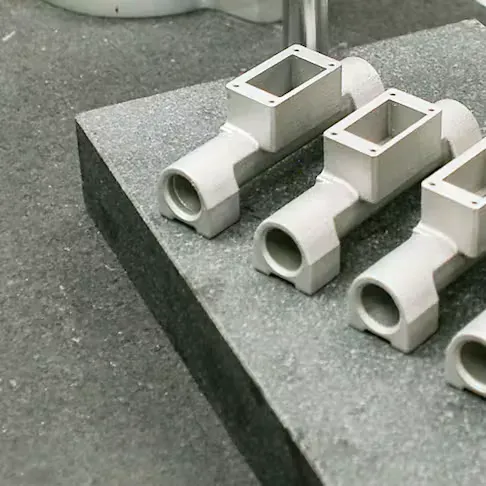
- SLS parts are strong, durable and handle heat better than most filament plastics.
- The surface is slightly grainy; parts can be dyed, sealed or painted.
How SLS works
A thin layer of nylon powder is spread across a heated build chamber. A laser traces the cross-section of the part, fusing the powder where it touches. The platform lowers, a new layer of powder is spread, and the process repeats until the parts are complete. The whole block then cools slowly before the parts are dug out and cleaned with air and blasting.
Why engineers like SLS
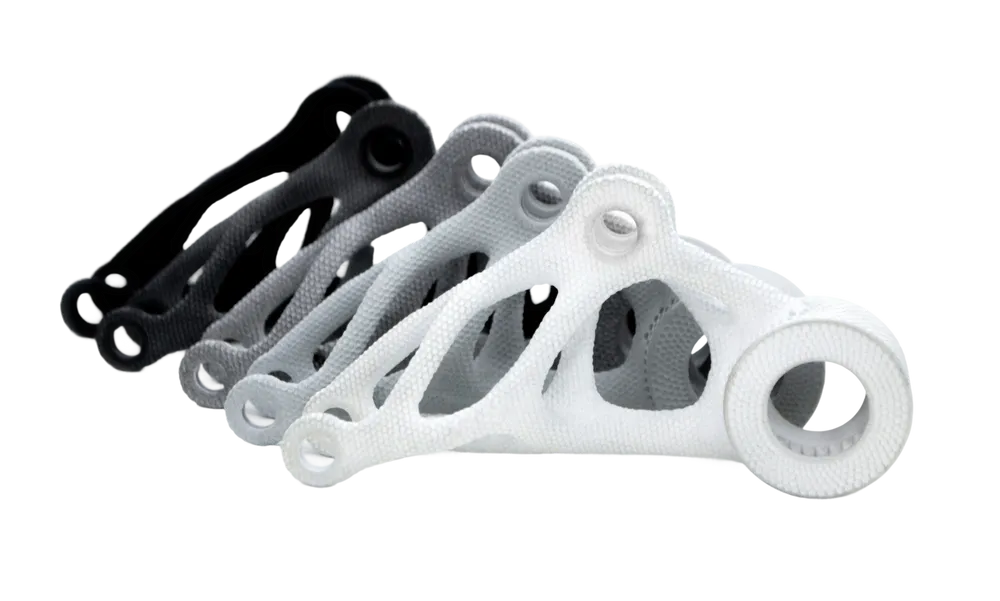
- No supports: the loose powder holds the part, so overhangs, internal channels and interlocking parts print cleanly
- Strength: nylon parts are tough and can take repeated use, clips and snap fits
- Heat: nylon handles higher temperatures than PLA, useful in the UAE climate
- Batch production: many parts can be nested in one build, which makes small batches economical
Surface finish and accuracy
SLS parts have a matt, slightly grainy surface and a natural white or grey colour. They can be dyed black, smoothed, sealed or painted. Accuracy is good for functional parts; very fine details and sharp text are better produced with resin (SLA).
| Finish option | Result |
|---|---|
| Bead blasting | Clean, even matt surface (standard) |
| Dyeing | Uniform colour, usually black |
| Vapour or chemical smoothing | Smoother, more sealed surface |
| Priming and painting | Any colour for presentation parts |
SLS compared with SLA and FDM
| SLS | SLA | FDM | |
|---|---|---|---|
| Material | Nylon powder | Liquid resin | Plastic filament |
| Strength | High | Medium, depends on resin | Medium |
| Detail | Good | Excellent | Moderate |
| Supports | None | Needed | Needed |
| Best for | Functional parts, small batches | Detailed models, smooth surfaces | Large, low-cost parts |
Multi Jet Fusion (MJF) is a related powder process that uses fusing agents and heat instead of a laser, with similar nylon parts. See our 3D printing materials guide for a fuller comparison.
Typical SLS uses
- Functional prototypes and test parts
- Brackets, clips, housings and enclosures
- Jigs, fixtures and tooling aids
- Replacement parts and short production runs
- Parts for drones, robotics and automotive testing
How ALCA Models can help
ALCA Models prints strong nylon parts by SLS for engineers, product teams and industry, and advises when SLS is the right choice over resin or filament.
- 3D printing in nylon PA12, resin and filament
- Functional prototypes that must fit, snap and be handled
- Replacement parts by reverse engineering and printing
Frequently asked questions
What does SLS stand for in 3D printing?
Selective laser sintering: a laser selectively fuses (sinters) nylon powder to build a part.
What material is used in SLS?
Mostly nylon PA12 and PA11, sometimes filled with glass or carbon fibre for extra stiffness.
Are SLS parts strong?
Yes. SLS nylon parts are among the strongest and most durable 3D printed plastic parts, suitable for functional use.
Is SLS more expensive than FDM?
Per part it is usually more expensive, but for small batches of complex parts it can be cost-effective because many parts print together.
Need strong nylon parts?
Send us your file, quantity and how the part will be used, and we will check whether SLS is the right process. See 3D printing in Dubai.