
Key points
- A prototype is a test version of a product, built to check an idea, a look, a function or a manufacturing detail.
- The main types are proof of concept, looks-like, works-like and pre-production prototypes.
- 3D printing is the fastest way to make most prototypes, often in days rather than weeks.
- Each round of prototyping should answer one clear question; that keeps cost and time under control.
What a prototype is for
Every product starts as an idea, a sketch or a CAD model. A prototype turns it into something you can hold, test and show. It answers questions that a screen cannot: does it fit in the hand, does the lid close, will the client understand it, can the factory make it?
Because a prototype is a question, not a product, it does not need to be perfect. It needs to be good enough to give a clear answer.
The four main types of prototype
| Type | Answers | Typical method |
|---|---|---|
| Proof of concept | Does the core idea work at all? | Quick FDM print, rough assembly |
| Looks-like (appearance) prototype | Does it look and feel right? | SLA resin print, sanded and painted |
| Works-like (functional) prototype | Does it fit, move and survive use? | SLS nylon or tough resin parts |
| Pre-production prototype | Is it ready for manufacturing? | Printed or cast parts close to final materials |
Many projects also need a presentation prototype: a looks-like model finished to a very high standard for investors, a client or an exhibition stand.
Low fidelity and high fidelity
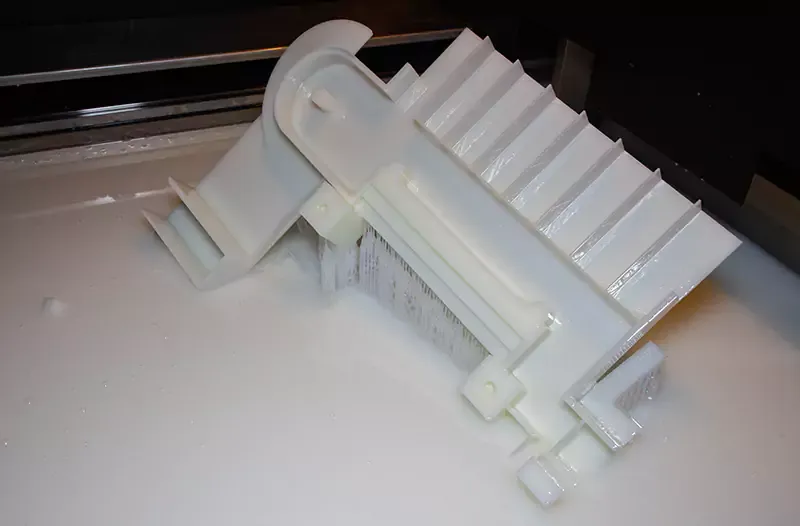
A low-fidelity prototype is quick and cheap: rough surfaces, wrong colour, sometimes wrong material. It is perfect for early decisions. A high-fidelity prototype looks and behaves like the real product and takes more time. Moving to high fidelity too early is one of the most common ways to waste a prototyping budget.
How prototypes are made
- 3D printing: the main method for most plastic prototypes. FDM for fast, low-cost form checks; SLA resin for fine detail and smooth surfaces; SLS nylon for strong, functional parts.
- Finishing: sanding, priming and painting turn a printed part into a presentation-quality object.
- Assembly: multi-part prototypes are printed in sections, bonded and finished so the joints do not show.
- Moulding and casting: used later, when several identical copies in a near-final material are needed.
See our 3D printing materials guide for how the printing processes compare.
How long does a prototype take?
| Prototype | Typical time |
|---|---|
| Simple single-part print | 2 to 4 working days |
| Multi-part or assembled prototype | 5 to 8 working days |
| Painted presentation prototype | 7 to 10 working days |
What to send for a prototype quote
- A 3D file (STEP, STL, OBJ or native CAD), or a sketch if no file exists yet
- The question the prototype must answer: look, fit, function or presentation
- Size, quantity, colour and finish
- Your deadline
How ALCA Models can help
ALCA Models makes prototypes for product designers, engineers and start-ups across the UAE and Saudi Arabia, from quick proof-of-concept prints to painted presentation prototypes.
- Rapid prototyping: concept, functional and presentation prototypes, usually in days
- 3D printing in SLA resin, SLS nylon and FDM, chosen for what the prototype must prove
- 3D scanning and reverse engineering when the prototype must fit an existing part
Frequently asked questions
What is the difference between a prototype and a model?
A prototype tests a product before it is made. A model, such as an architectural or display model, represents something for presentation. The same 3D printing methods are used for both.
What is a proof of concept prototype?
The simplest prototype, made only to show that the core idea works. It is usually rough and quick.
Can a prototype be made without a CAD file?
Yes. A designer can create the 3D model from a sketch, drawing or existing part; this is quoted separately.
Is 3D printing the cheapest way to make a prototype?
For one-off and small numbers of plastic parts, usually yes, because there is no tooling. For hundreds of identical parts, moulding becomes cheaper.
Make your prototype
Send us your file or sketch and tell us what the prototype needs to prove. We will recommend the process and send a price and date. See rapid prototyping in Dubai.